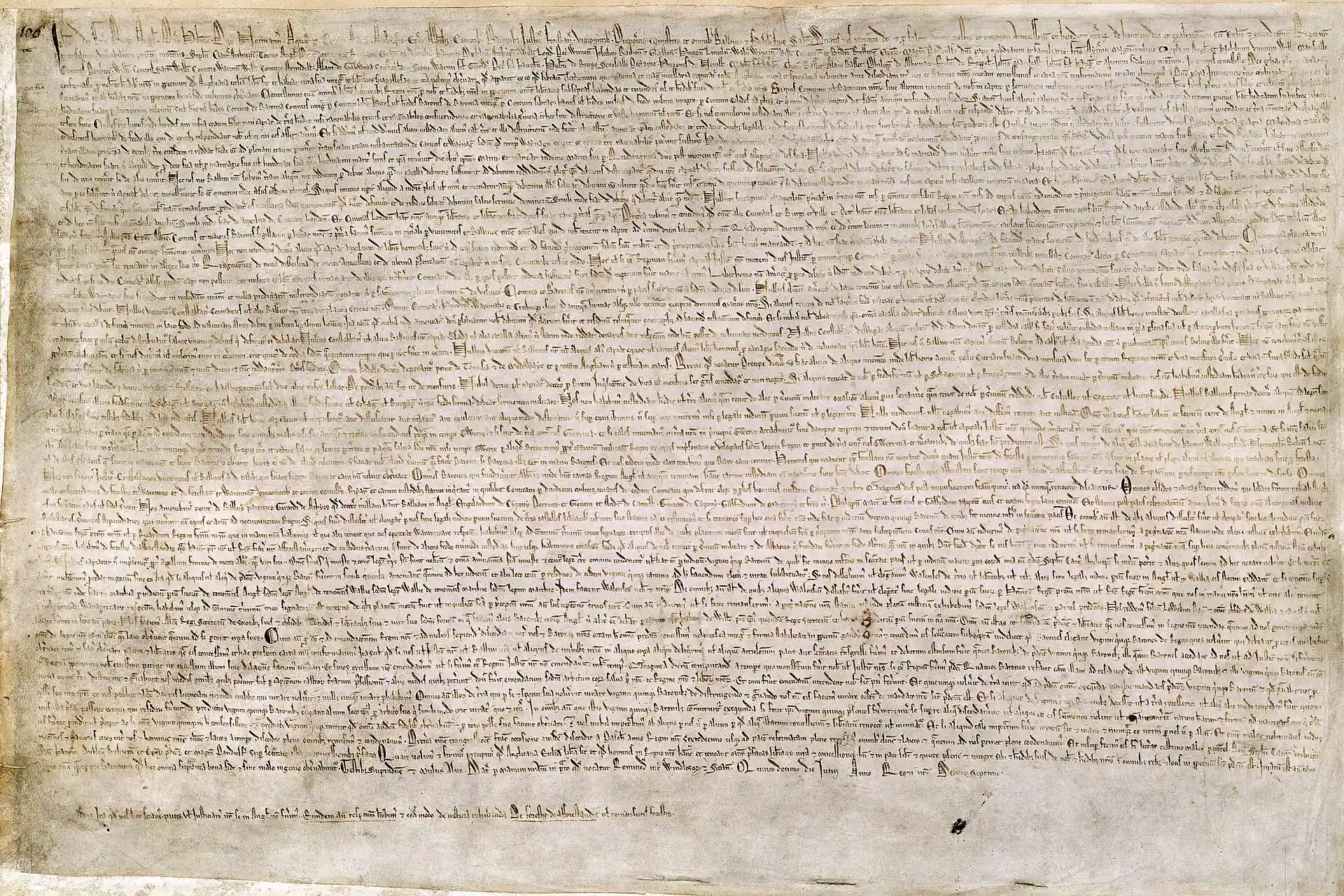
In 1215, England was the stage for a monumental struggle for power that resulted in one of the most famous legal documents in history: the Magna Carta. While this "Great Charter" is the year's defining legacy, 1215 was also marked by global conquests, religious upheaval, and the birth of future world leaders.
The Magna Carta and the Barons' War
The Magna Carta (Latin for "Great Charter") was born from a crisis of governance. King John, the third of the Angevin kings, had become deeply unpopular due to heavy taxation, unsuccessful wars in France, and his arbitrary exercise of power known as vis et voluntas ("force and will"). In early 1215, a group of rebel barons renounced their loyalty to the King and captured London.
On June 15, 1215, at Runnymede, King John was forced to meet the barons and their mediator, Archbishop Stephen Langton. He sealed the charter, which established for the first time that the monarch was not above the law. Key provisions included:
- Protection of Church rights.
- Due Process: The famous Clause 39 declared that no free man could be imprisoned or stripped of rights except by the lawful judgment of his peers or the law of the land.
- Swift Justice: A promise not to sell, deny, or delay justice.
- Clause 61 (Security Clause): A council of 25 barons was established to monitor the King and seize his lands if he failed to uphold the agreement.
The peace was short-lived. By August, King John appealed to Pope Innocent III, who annulled the charter, calling it "illegal and shameful." This sparked the First Barons' War, leading the rebels to invite Prince Louis of France to claim the English throne.
Other Major Events of 1215
While England was embroiled in civil war, significant events were reshaping the rest of the world:
- The Mongol Conquest of China: In the East, Genghis Khan’s forces achieved a massive victory by capturing Zhongdu (modern-day Beijing) on June 1. The city was devastated and burned for a month, marking a critical turning point in the Mongol conquest of the Jin dynasty.
- The Fourth Lateran Council: In November, Pope Innocent III convened one of the most important church councils of the Middle Ages in Rome. It defined the doctrine of transubstantiation, mandated annual confession for Christians, and formally approved the proposal for the Fifth Crusade. It also banned clerical participation in "trial by ordeal," a major shift in European legal history.
- The Rise of Frederick II: In July, the 20-year-old Frederick II was crowned King of the Romans in Aachen, setting the stage for his long and influential reign as Holy Roman Emperor.
- Birth of Kublai Khan: On September 23, Kublai Khan was born. He would eventually succeed his grandfather Genghis Khan, founded the Yuan dynasty in China, and became the first Mongol to rule over all of China.
Legacy
Though the 1215 Magna Carta failed as a peace treaty and was quickly annulled, it was reissued in subsequent years (notably 1216, 1217, and 1225). Over centuries, it evolved from a specific list of baronial grievances into a universal symbol of liberty, profoundly influencing the U.S. Constitution and the Bill of Rights.