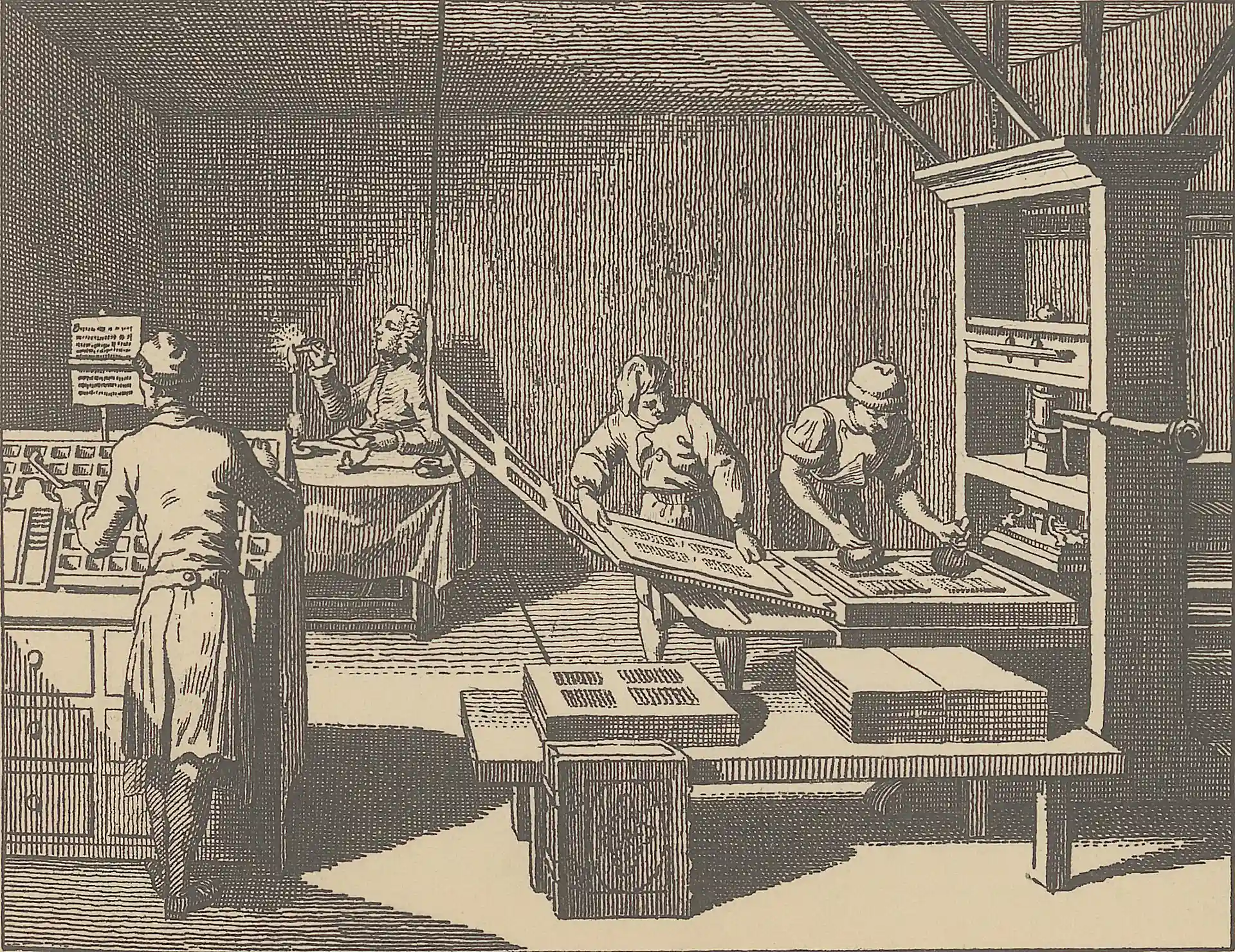
Invented around 1440 in Germany by goldsmith Johannes Gutenberg, the mechanical movable-type printing press revolutionized the production of books and catalyzed the Printing Revolution. Prior to this invention, books were meticulously hand-copied or printed using slow woodblock techniques.
Gutenberg's genius lay in synthesizing and improving existing technologies into a single, highly efficient system. His most significant innovation was the hand mould (matrix), which allowed for the precise, rapid mass production of durable metal movable type from a lead-based alloy. He also adapted traditional screw presses—commonly used for pressing wine and olives—to apply even, elastic pressure onto a flat printing surface. Additionally, Gutenberg developed a new oil-based ink that adhered perfectly to metal type without soaking the paper, a major improvement over existing water-based inks.
Together, these advancements mechanized the printing process. A single Gutenberg press could produce up to 3,600 pages per workday, compared to just forty by hand-printing. His most famous work, the 42-line Gutenberg Bible, demonstrated the system's ability to produce high-quality texts. By drastically reducing the cost of literature, the press sparked an era of mass communication that permanently altered society, fueling the Reformation, the Scientific Revolution, and a dramatic rise in global literacy.