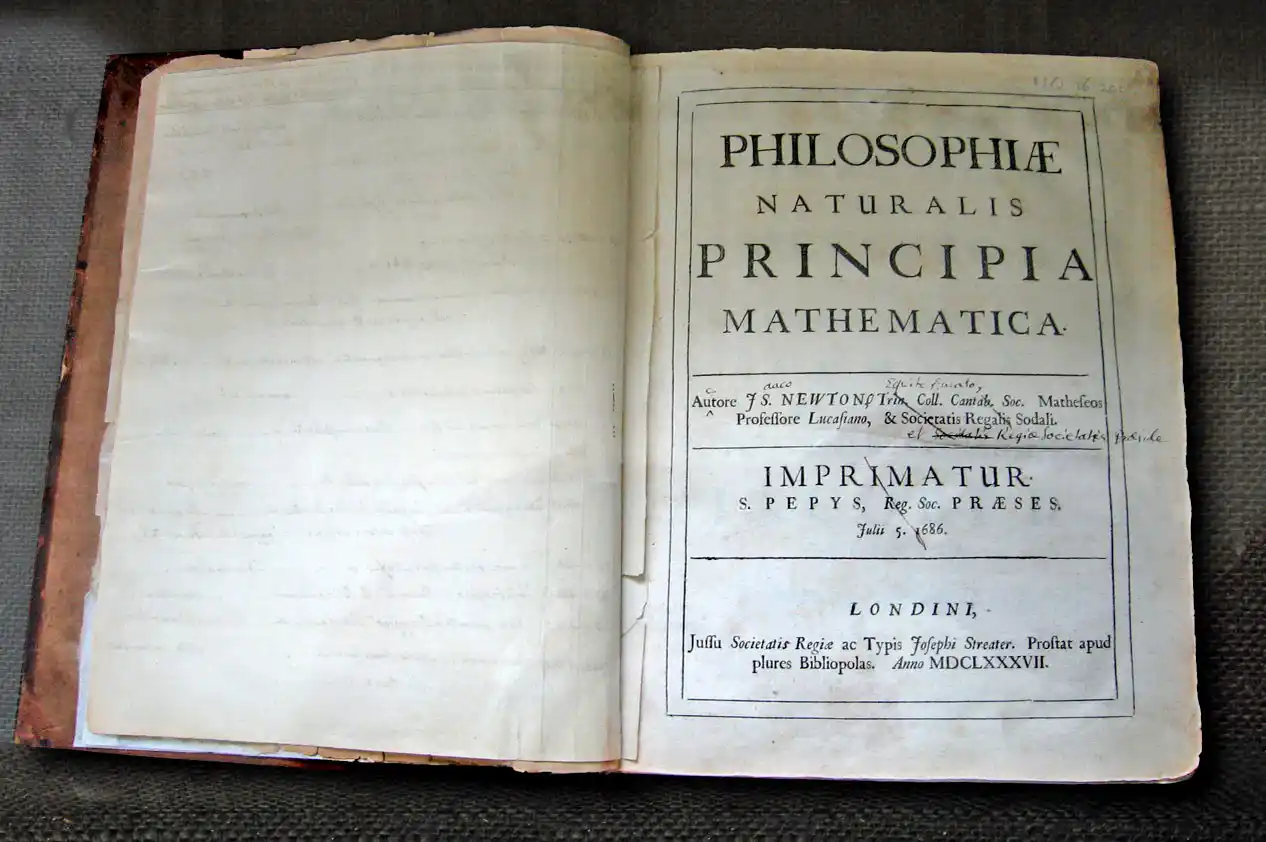
In 1687 CE, Sir Isaac Newton published his magnum opus, Philosophiæ Naturalis Principia Mathematica (Mathematical Principles of Natural Philosophy). Written in Neo-Latin, this foundational text is widely celebrated as one of the most important single works in the history of science. Its publication marked a monumental turning point in human thought, providing a rigorous mathematical framework for understanding the physical universe and solidifying the scientific revolution.
The realization of the Principia in 1687 was heavily dependent on the diplomatic and financial support of astronomer Edmond Halley. After visiting Newton and discovering his groundbreaking, yet unpublished, calculations on planetary orbits, Halley urged him to expand his work. When the Royal Society lacked the funds to publish the finalized manuscript—having depleted their budget on a previous book about fish—Halley personally financed the printing. Despite priority disputes with Robert Hooke that nearly caused Newton to withdraw the crucial third volume, Halley's tactful mediation ensured the complete, three-volume work was successfully published in the summer of 1687.
The Principia is structured into three comprehensive books. The first two, De motu corporum (On the motion of bodies), establish Newton's three laws of motion, examining bodies moving in both vacuums and resisting fluid mediums. Here, Newton utilized a geometrical form of infinitesimal calculus to mathematically define his dynamic concepts. The third book, De mundi systemate (On the system of the world), applies these established dynamics to the cosmos. It introduces the law of universal gravitation, successfully explaining Johannes Kepler's empirical laws of planetary motion, the eccentric orbits of comets, and the gravitational mechanics of ocean tides.
By effectively uniting terrestrial and celestial mechanics under a single set of physical laws, the 1687 publication of the Principia established the absolute bedrock of classical mechanics. It replaced centuries of philosophical conjecture with empirical, mathematically verifiable realities, fundamentally transforming humanity's scientific understanding of the cosmos.