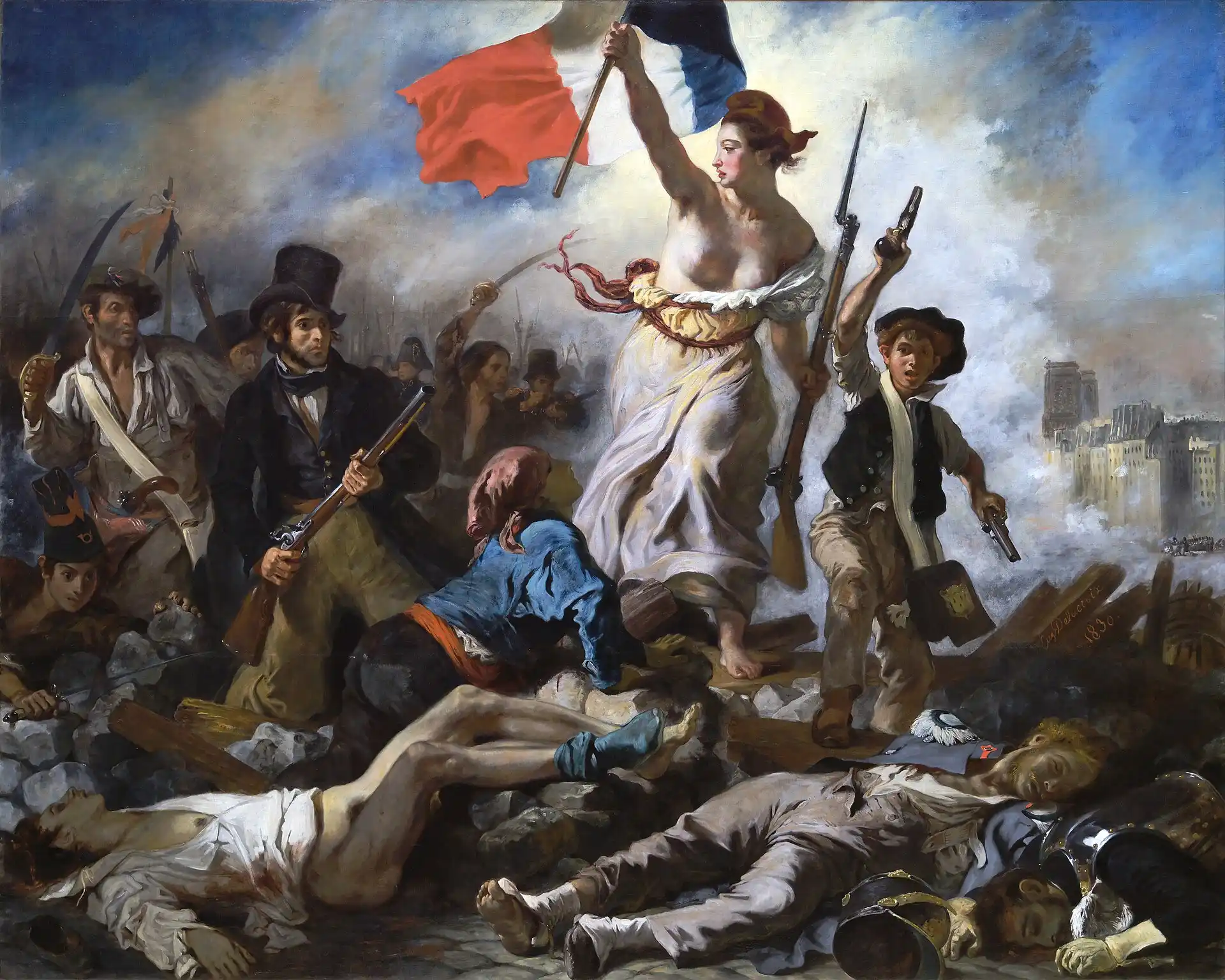
The French Revolution was a major watershed event in modern European history lasting from 1789 until the late 1790s. During this period, French citizens radically altered their political landscape, uprooting centuries-old institutions like absolute monarchy and the feudal system. The upheaval was caused by widespread discontent with the French monarchy and the poor economic policies of King Louis XVI, who ultimately met his death by guillotine. Although it degenerated into a chaotic bloodbath at times, the Revolution played a critical role in shaping modern nations by demonstrating the immense power inherent in the will of the people.
The Revolution's roots stemmed from severe financial crises and deep-seated social inequalities. France was divided into three Estates. The First (clergy) and Second (nobility) Estates enjoyed massive privileges and tax exemptions, while the Third Estate, comprising peasants and the bourgeoisie, bore the entire brunt of taxation. Decades of fiscal mismanagement, coupled with costly wars, left the French crown deeply in debt. Furthermore, poor harvests and skyrocketing bread prices kindled unrest among the poor. Enlightenment ideals promoting liberty, equality, and the challenge to absolute authority provided the intellectual framework for this massive societal rebellion.
Seeking to resolve the financial crisis, Louis XVI convened the Estates-General in May 1789 for the first time since 1614. The Third Estate quickly clashed with the other two over voting rights. Frustrated by archaic rules that allowed them to be outvoted, the Third Estate declared themselves the National Assembly. Days later, they took the famous Tennis Court Oath, vowing not to disperse until they had drafted a new constitution. This marked the beginning of a peaceful political revolution, but mounting tensions ensured the situation would rapidly escalate into violent physical confrontation.
On July 14, 1789, an enraged Parisian mob stormed the Bastille, a medieval fortress symbolizing royal tyranny. This officially ignited the Revolution and inspired agrarian revolts known as the Great Fear. By August, the Assembly adopted the Declaration of the Rights of Man and of the Citizen, proclaiming equality, freedom of speech, and popular sovereignty. In October, thousands of Parisian women marched on Versailles to protest bread prices, forcing the royal family to return to Paris. This effectively made the monarch a prisoner of the revolution and shifted the balance of power permanently.
The early Revolution attempted to establish a constitutional monarchy. In 1791, a new constitution heavily restricted the king's powers. However, Louis XVI’s disastrous attempt to flee the country shattered public trust. Meanwhile, neighboring European powers threatened to intervene to restore the absolute monarchy. In April 1792, France declared war on Austria and Prussia. Radicalization of the public, fueled by war and suspicion, led to the suspension of the king's powers in August. A month later, the National Convention abolished the monarchy entirely and declared France a republic.
The First French Republic ushered in the Revolution's most violent phase. In January 1793, Louis XVI was executed for treason. Control was seized by the radical Jacobins, led by Maximilien Robespierre. To eradicate alleged counter-revolutionaries, they initiated the Reign of Terror, a ten-month period where suspected enemies were guillotined by the thousands. The excessive bloodshed eventually alienated the public, leading to Robespierre's own execution in July 1794. This event, now known as the Thermidorian Reaction, ended the Terror and marked a definitive shift toward more moderate, conservative government policies.
Following the Terror, executive power was entrusted to a five-member Directory in 1795. Their four years in power were riddled with financial crises, corruption, and popular discontent. They maintained authority largely through military force, relying on a successful young general named Napoleon Bonaparte. In November 1799, as frustration peaked, Napoleon staged a bloodless coup d'état, abolishing the Directory and appointing himself "First Consul." This effectively ended the French Revolution and began the Napoleonic era, which would fundamentally alter Europe's geopolitical map for the next fifteen years.
Despite its violent excesses and the return to authoritarianism, the Revolution's legacy is profound. It dismantled European feudalism, diminished the Catholic Church's political power, and introduced foundational democratic principles like equality before the law and human rights. The revolutionary motto of "Liberty, Equality, Fraternity" became a universal rallying cry, inspiring global independence movements and laying the groundwork for the modern political era.