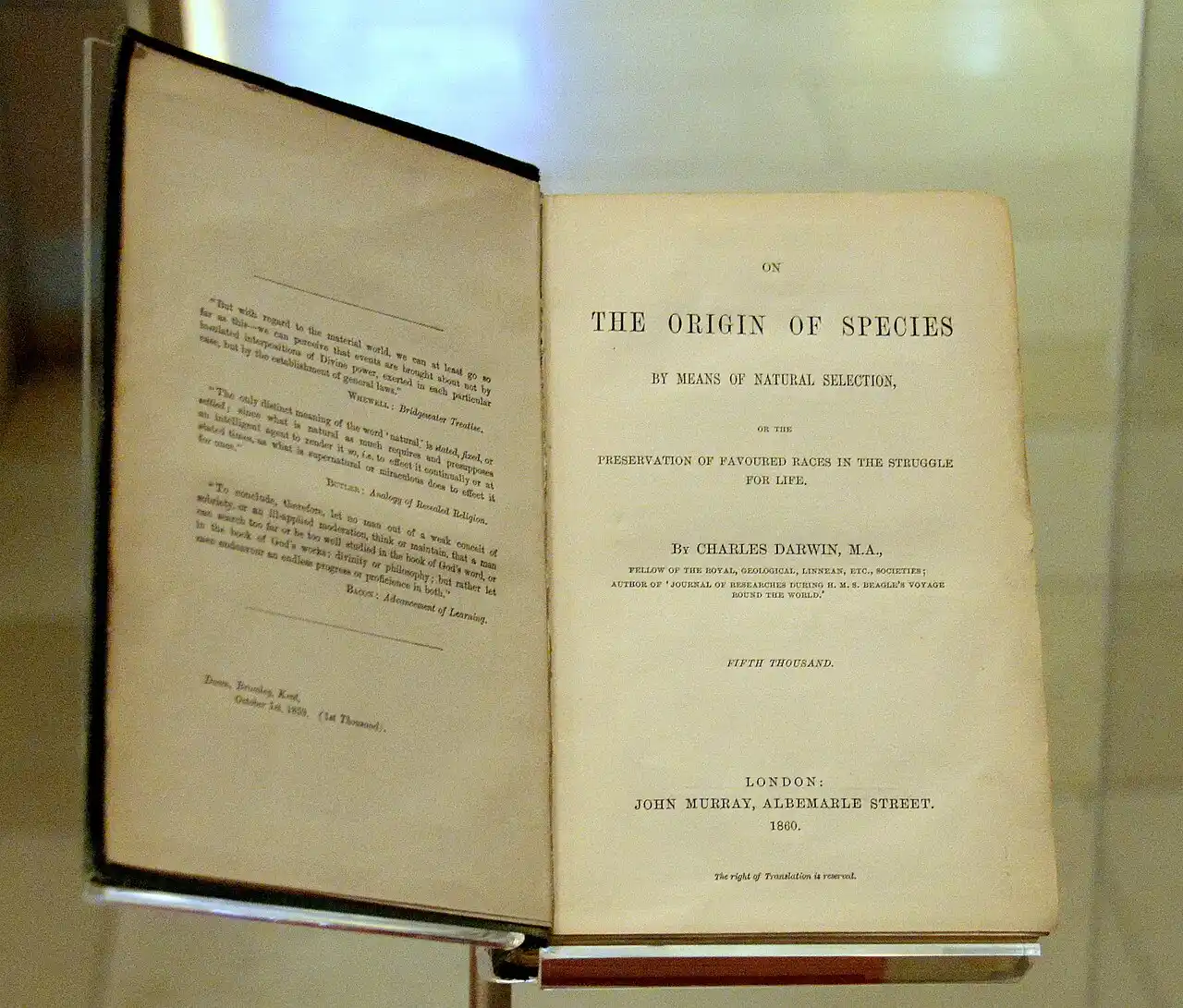
Published on November 24, 1859, Charles Darwin's "On the Origin of Species" is a foundational text in scientific literature and the cornerstone of evolutionary biology. The book introduced the revolutionary theory that populations evolve over generations through natural selection. It presented a compelling body of evidence showing that the diversity of life arose from common descent through a branching pattern of evolution, utilizing data Darwin gathered during his 1830s Beagle expedition and decades of subsequent research.
The core of Darwin’s thesis is the mechanism of natural selection. He posited that individuals within a species exhibit variation in their traits, and those with characteristics better suited to their environment are more likely to survive and reproduce. Over time, these advantageous, heritable traits accumulate in the population. This continuous process of adaptation explains how populations change over vast periods of time, eventually diverging enough to form entirely new species without the need for divine intervention.
The publication of the book provoked intense public and scientific debate. It challenged the predominant scientific and religious doctrines of the Victorian era, which maintained that species were immutable and individually created by God. Although the scientific community began to gradually accept the general concept of evolution, natural selection as the primary mechanism faced resistance. It wasn't until the modern evolutionary synthesis in the 20th century that Darwin's proposed mechanism was fully vindicated and universally accepted.
Today, "On the Origin of Species" stands as one of the most influential books in human history. Darwin’s insights fundamentally shifted humanity’s understanding of the natural world and our place within it. While Darwin lacked an understanding of genetics, modern molecular biology has seamlessly integrated with his theories, proving the physical basis for heredity. Ultimately, the book transformed biology into a cohesive, evidence-based science, providing a unified framework that remains central to all biological research today.