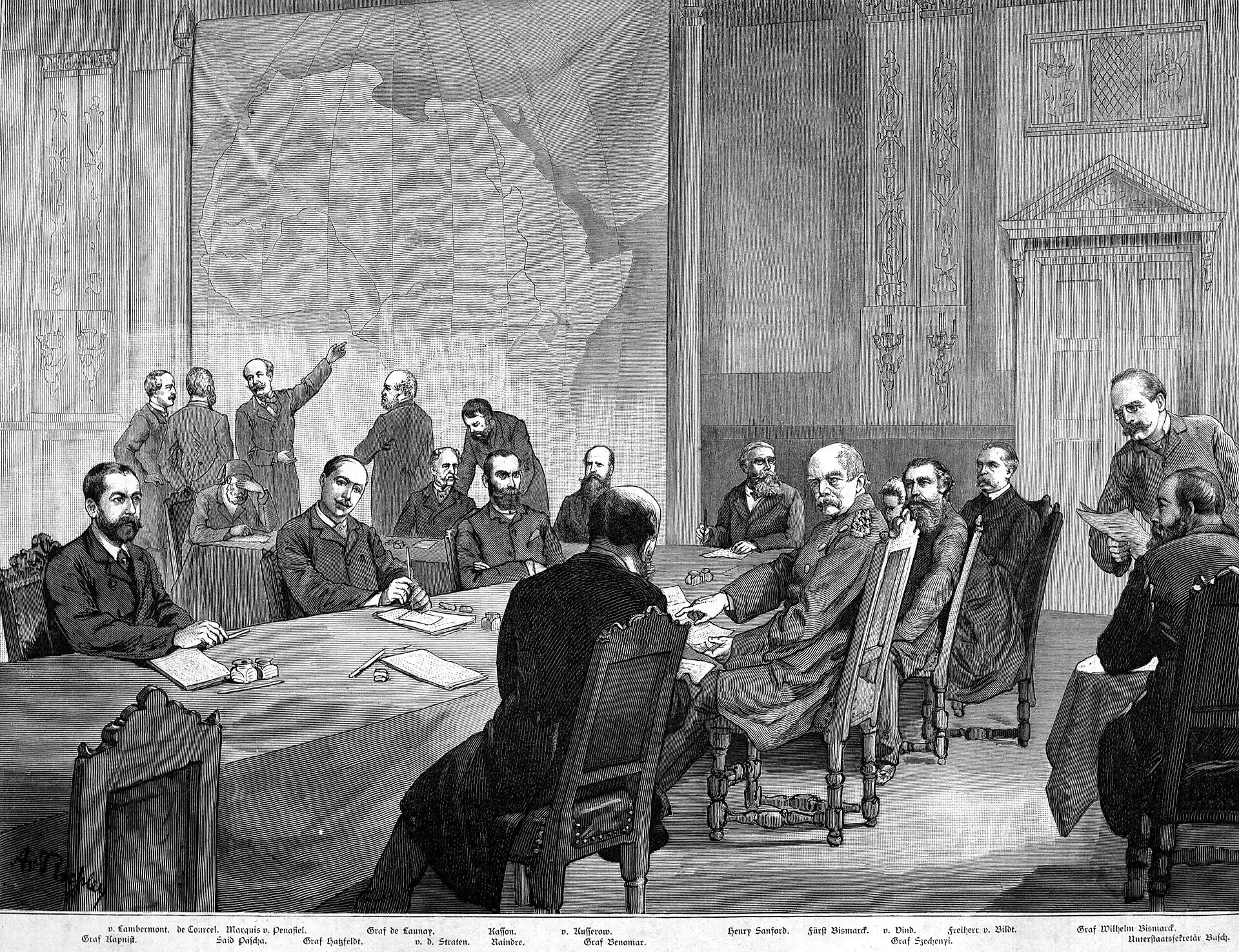
The Berlin Conference of 1884–1885, organized by German Chancellor Otto von Bismarck, was a pivotal meeting of fourteen nations that fundamentally altered the political landscape of the African continent. Concluding on February 26, 1885, the conference resulted in the signing of the General Act of Berlin. This landmark agreement established a unified, international legal framework that regulated European colonization and trade during the era of New Imperialism, shifting the European presence in Africa from scattered coastal trading posts to massive territorial conquests.
The year 1885 marked the exact moment when the Scramble for Africa was officially formalized. While European powers were already fiercely competing for control over Africa's vast markets and natural resources, the General Act created diplomatic rules to prevent outright war among rival empires. The most critical doctrine introduced was the Principle of Effective Occupation. This rule dictated that European nations could no longer simply claim territorial sovereignty on paper; they had to prove "effective occupation" by establishing administrative governance, deploying police forces, flying their flags, and making use of the region economically. This forced colonial powers to physically push deep into the African interior to secure their land grabs.
Driven by the booming industrial revolution, nations like Britain, France, and Germany desperately sought raw materials such as rubber, minerals, ivory, and cotton. A major outcome of the 1885 agreement was the resolution of disputes surrounding the resource-rich Congo Basin. The conference recognized the territorial claims of the International Congo Society, which functioned as a front for Belgium's King Leopold II. Shortly after the conference in August 1885, this vast territory was officially consolidated as the Congo Free State, heavily exploited under Leopold's brutal personal rule. The agreement also guaranteed free trade and open ship navigation along the vital Niger and Congo rivers.
Ultimately, while modern historians note that the 1885 conference did not immediately draw the final borders of modern Africa, it provided the crucial legal justification for the colonial partition. By legitimizing the rapid carving up of the continent, the Berlin Conference accelerated imperial expansion, ensuring that within a few decades, nearly 90% of Africa would fall under direct European control.